
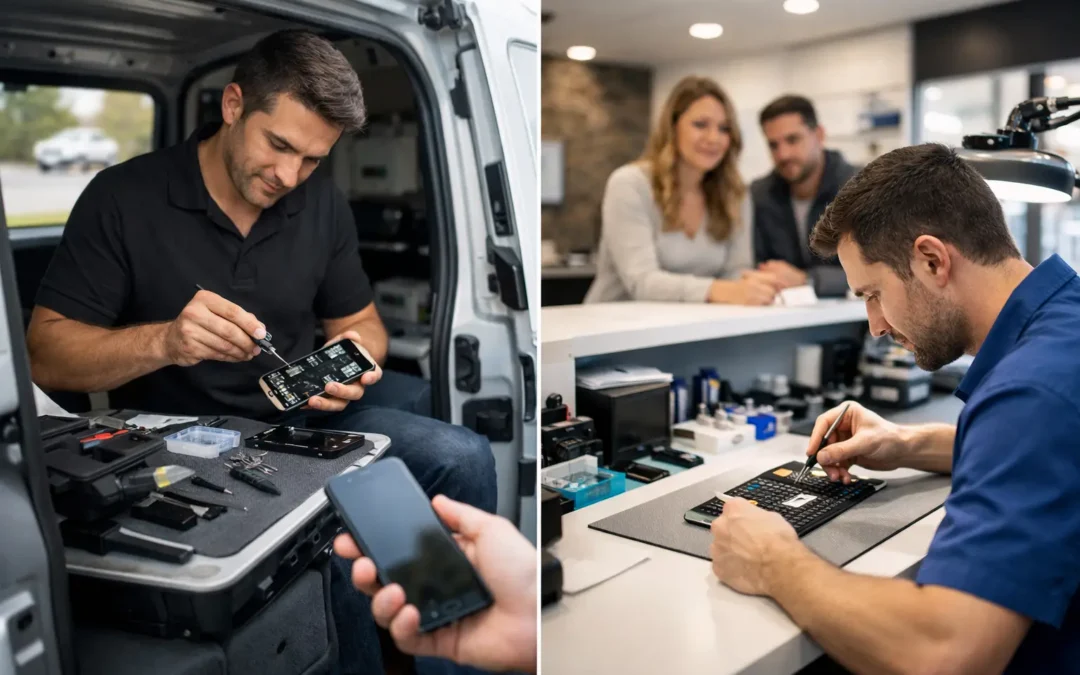
A cracked screen at 8 a.m. feels different when you need your phone for work, your child’s school pickup, or a customer call. That is why the choice between onsite phone repair versus store repair is not just about where a technician works. It is about how quickly you can get back to normal, what kind of damage your device has, and how much interruption you can afford.
For many Houston customers, onsite repair is the fastest answer to a straightforward problem. For others, bringing a device into a repair store provides the better environment for detailed diagnostics, water damage recovery, or a complicated computer issue. The right option depends on the repair, your schedule, and the condition of the device.
What Onsite Phone Repair Is Best For
Onsite repair brings a trained technician to your home, office, school, or another convenient Houston-area location. Instead of rearranging your day around a repair visit, you choose a place where you already need to be.
This service is especially useful for common, visible phone problems. A cracked iPhone screen, damaged Samsung screen, worn-out battery, charging port issue, or failing camera can often be diagnosed and repaired without asking you to sit in traffic, find parking, or spend time in a waiting room. If the repair is simple and the needed part is available, the biggest benefit is obvious: your phone stays close, and your day keeps moving.
Onsite repair also makes sense for busy households. Parents do not always have time to load everyone into the car for a broken tablet. Professionals may not be able to leave a job site when a work phone stops charging. Small business owners can lose real money when a device is down. In these situations, having a technician come to you can be more valuable than saving a few minutes on the repair itself.
There is also a practical comfort factor. You know where your device is, who is handling it, and when the work is being done. For a standard screen replacement, that visibility can provide real peace of mind.
The Limits of Mobile Repairs
Convenience does not mean every repair belongs in a parking lot, living room, or office lobby. Some problems need more than replacement parts and a quick test. A phone with severe water damage may require deeper inspection, internal cleaning, corrosion treatment, or repeated testing. A device that keeps restarting may have a battery problem, software issue, board-level failure, or damage caused by a previous repair.
Mobile technicians also have to work with the conditions available. Extreme Houston heat, rain, low lighting, limited workspace, or a crowded location can make delicate work less practical. A good repair company will tell you when an onsite appointment is the right fit and when a store repair will give your device a better chance of a lasting fix.
When Store Repair Is the Better Choice
A retail repair location gives technicians a controlled workspace, specialized tools, diagnostic equipment, and access to a wider range of parts. That matters when the problem is not immediately clear or when the device needs to be opened, tested, and monitored carefully.
Store repair is often the better route for serious water damage, motherboard concerns, software failures, data recovery questions, and devices with multiple issues. It is also the stronger option for laptops and desktop computers. A laptop that will not boot, runs unusually hot, has malware, or needs a new charging jack may require more testing than a quick onsite visit allows.
Bringing a device into a store can also help if you are unsure what is wrong. Maybe your phone battery drains quickly, but it is not clear whether the battery, charging cable, software, or an app is responsible. Maybe your tablet screen is cracked and the touch response is inconsistent. A technician can inspect the device, explain what they find, and recommend the repair that actually addresses the cause.
For customers who prefer to drop off a device and return after work, store repair is often easier than coordinating an appointment window. Phone Repair Ambulance’s local locations give Houston customers a place to bring urgent phone, tablet, laptop, and desktop problems when hands-on diagnostics are needed.
More Workspace Can Mean Better Testing
A repair is not complete just because a new screen lights up. The technician should check touch response, cameras, speakers, microphones, Face ID or fingerprint features when applicable, charging performance, buttons, and overall function. Store-based repairs can be especially helpful when a device needs extended testing after service.
That does not mean onsite work is lower quality. It means the setting should match the job. A straightforward screen repair may be perfect for a mobile appointment. A phone with intermittent shutdowns and liquid exposure deserves the extra evaluation a store environment supports.
Onsite Phone Repair Versus Store Repair: Speed and Cost
Customers often assume onsite service is always faster and store repair is always cheaper. The reality is more specific.
Onsite service can save the most total time because there is no drive, no waiting in line, and no extra trip to pick up the device. If you need a common repair completed at your workplace, the convenience may easily outweigh any service-call difference. This is why onsite repair is popular for urgent screen and battery issues.
Store repair can be faster when the device needs diagnostics, specialized equipment, or a part that is not included in a mobile technician’s inventory. A store may also be the quickest path if you live near a location and can drop the device off immediately. For advanced problems, trying to force a mobile repair can lead to delays. Choosing the right setting first is usually the true time-saver.
Cost depends on the model, the damage, part availability, and the type of repair. The best approach is to ask for a clear quote before work starts. Be cautious with prices that sound too low to be realistic. Cheap parts can affect screen brightness, touch sensitivity, battery life, or long-term reliability. A quality repair should focus on the right part, skilled installation, and testing after the work is done.
Privacy and Security Considerations
Your phone holds more than contacts. It may contain work email, banking apps, family photos, private messages, passwords, and account access. Whether you choose onsite or store repair, use a repair provider that treats that responsibility seriously.
Before your appointment, back up your device if possible and remove any accessories you need to keep. If the phone works, know your passcode and be ready to provide it only when it is necessary for testing. Some repairs can be checked without full access, while others require you to unlock the device so the technician can test functions properly.
For computer repairs, store service may be more appropriate when malware removal, operating system repair, or data issues are involved. Those jobs can take time, require multiple restarts, and need careful follow-up testing. A technician should explain the process in plain language and tell you what to expect before work begins.
How to Choose the Right Repair Option
Start with the problem in front of you. If you have a cracked screen, weak battery, damaged camera, or charging issue on a phone that otherwise works normally, onsite repair may be the most convenient solution. It keeps you close to your responsibilities and avoids an unnecessary trip.
Choose store repair when there is water damage, no power, repeated crashing, an unknown issue, a bent frame, multiple damaged components, or a laptop or desktop problem that needs more investigation. The same goes for devices that were already repaired elsewhere but still are not working correctly.
Availability matters, too. Same-day service is valuable, but it should include an honest assessment of what can be done that day. Ask whether the part is in stock, how long testing will take, and whether the repair comes with clear communication about its status. You should not be left wondering where your device is or what happened after you handed it over.
A broken phone should not force you to choose between getting help and handling the rest of your life. Pick the repair option that fits the damage and your schedule, then let a qualified local technician take it from there.