
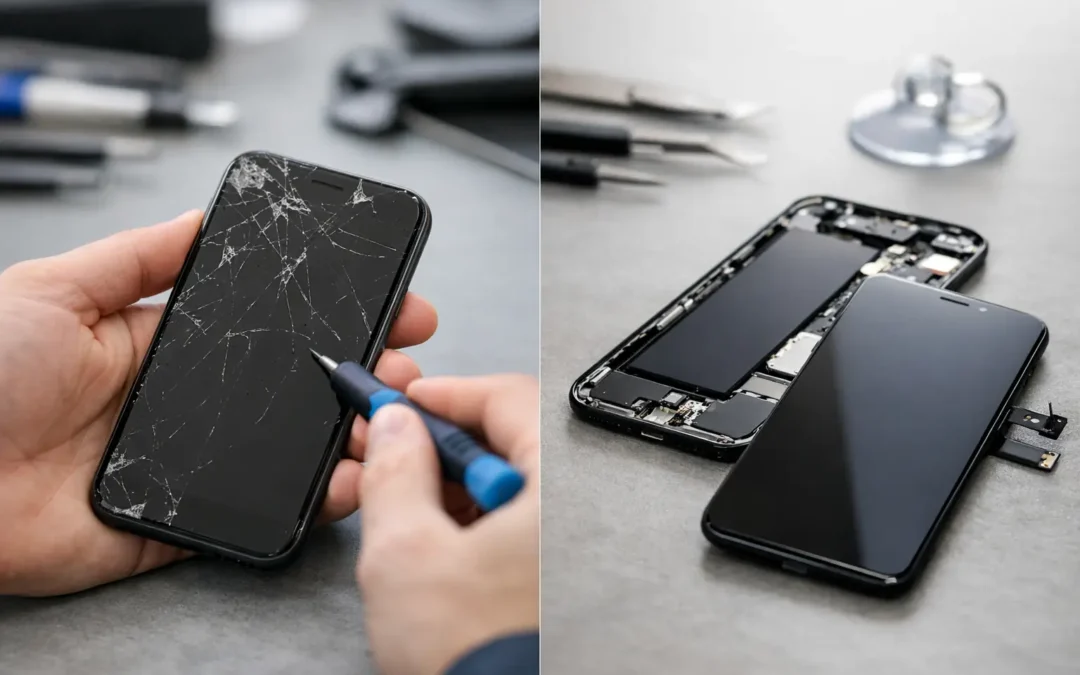
That tiny crack in the corner rarely stays tiny for long. If you are weighing iPhone screen repair vs replacement, the real question is not just cost – it is how fast you need your phone back, how bad the damage is, and whether the screen can still do its job without causing bigger problems.
For most people, this decision happens at the worst possible time. You drop your phone on the way to work, your kid steps on it after school, or it slips off the kitchen counter right before a trip. Now you need a clear answer, not a lecture. Here is how to tell whether your iPhone screen can be repaired, when it needs full replacement, and what matters before you spend money.
iPhone screen repair vs replacement: what is the difference?
People often use these terms like they mean the same thing, but they do not always.
Screen repair usually means fixing a limited issue without replacing every display component. That might involve addressing surface glass damage in certain cases, securing loose parts, or correcting a problem that affects how the screen sits or responds. On some devices, though, what customers call a repair is still technically a full screen assembly swap because modern iPhones are built in layers that work together.
Screen replacement means removing the damaged display assembly and installing a new one. That is the more common solution for cracked glass, dead pixels, black spots, touch failure, flickering, or display separation. With newer iPhones, replacement is often the most reliable path because the glass, digitizer, and OLED or LCD panel are closely integrated.
That is why the answer is often simpler than people expect. If the damage is purely cosmetic and very minor, a limited repair may be possible. If the phone has display issues, touch issues, spreading cracks, or exposed internals, replacement is usually the safer call.
When a repair might be enough
There are situations where a full replacement may not be necessary right away.
If the crack is small, the display looks normal, touch works everywhere, Face ID functions, and there are no lines, bleeding spots, or lifting edges, some customers choose to keep using the phone or ask for an inspection before committing to a full replacement. In a few cases, the issue may be less severe than it looks. A chip at the edge or a shallow surface crack might not affect performance immediately.
But there is a catch. Even a minor crack weakens the screen. Once that top layer is compromised, normal pressure from your pocket, backpack, car mount, or daily tapping can turn a manageable issue into a fully broken display. Moisture and dust can also work their way in through the damaged area.
So yes, a repair or temporary hold-off can make sense when the phone still works normally. It just depends on your risk tolerance. If you use your phone for work, school, navigation, or payments, waiting can cost more than fixing it now.
When replacement is the better choice
In most real-world cases, replacement wins because it solves the full problem at once.
If your screen has blacked out sections, green or white lines, ghost touch, dead touch zones, flickering, or glass that is separating from the frame, a repair is unlikely to be enough. The screen assembly has already been compromised beyond a cosmetic issue. The longer you wait, the more likely the phone will become harder to use or stop responding entirely.
Replacement also makes sense when the crack spreads across the viewing area or creates sharp edges. That is not just annoying. It can interfere with swiping, typing, reading messages, and using apps safely. If pieces of glass are flaking off, replacement should move from optional to urgent.
For newer iPhone models, replacement is also the more dependable solution because it restores the screen as a matched component rather than trying to preserve a failing one. When speed and reliability matter, that matters.
The biggest factors in your decision
The first factor is functionality. If the phone still displays clearly and responds correctly to touch, you may have more room to choose. If performance is already affected, replacement is usually the practical answer.
The second factor is cost versus risk. Some people hesitate because they want the cheapest option. That makes sense. But the cheapest option is not always the lowest total cost. A delayed fix can lead to deeper damage, especially if pressure or moisture reaches internal components.
The third factor is turnaround time. A lot of customers think replacement means being without a phone for days. It does not have to. With the right local shop, screen replacement can often be done the same day, and in some cases much faster than people expect.
The fourth factor is phone value. If you plan to trade in, sell, or keep your iPhone for another year or two, a damaged screen drags down both usability and resale value. A proper replacement can protect that value better than trying to live with damage.
Why DIY is usually the wrong move
Screen kits online make this look easy. It is not.
Modern iPhones are compact, delicate, and packed with components that do not forgive mistakes. One wrong move during opening can damage flex cables, front sensors, or internal connectors. Even if you manage to install a new screen, poor-quality parts or improper sealing can lead to touch issues, brightness problems, or reduced durability.
There is also the matter of calibration and fit. A screen that is slightly off can affect responsiveness and overall feel. Most people looking up iPhone screen repair vs replacement are trying to save time and stress. DIY usually does the opposite.
If your phone is a daily necessity, professional service is usually the faster and safer route.
What a good repair shop should tell you
A trustworthy shop should not push one answer before inspecting the phone. They should explain what is damaged, whether a limited repair is realistic, and whether replacement is the more reliable fix.
They should also be clear about timing, parts quality, and whether other issues may be hiding under the screen damage. A hard drop can affect more than the display. The frame may be bent, the battery may have shifted, or internal connectors may be stressed.
Good service is not about using technical language. It is about giving you a straight answer quickly. If you are in Houston and need speed without guesswork, that is exactly why local shops like Phone Repair Ambulance focus on same-day solutions and clear repair status updates.
Common screen damage scenarios
A hairline crack with full screen function is the gray area. You may be able to wait a little, but the risk of worsening damage is real.
A shattered front with normal display but rough glass usually points to replacement, especially if the phone is used heavily every day. Even when the picture looks fine, the structural damage is already there.
A screen with lines, dark patches, or touch failure is not really a maybe. That is replacement territory.
A screen that lifts away from the frame may involve more than impact damage. It can also point to swelling underneath, which should be checked right away.
Is it worth replacing the screen on an older iPhone?
Usually, yes – but it depends on the model and the rest of the phone.
If the battery is decent, the phone runs well, and the screen is the main issue, replacement is often worth it. It is usually less expensive than buying another device, and it gets you back to normal fast.
If the phone already has multiple problems, like poor battery life, charging issues, camera failure, or water damage, then it may be smarter to weigh repair costs against replacement of the whole device. That is where an honest inspection matters. You do not want to put money into a phone that is already near the end of its useful life.
Still, many older iPhones have plenty of life left in them. A broken screen alone does not mean the phone is done.
The practical answer most customers need
If the damage is minor and everything works, you may have a short window where repair or monitored use makes sense. If the screen is affecting visibility, touch, safety, or structural integrity, replacement is the better decision.
The key is acting before the damage spreads. A cracked screen rarely improves with time. It usually gets more expensive, more frustrating, and more disruptive.
If your phone is how you handle work calls, school updates, banking, maps, and family messages, the best choice is usually the one that gets you back to a dependable device fast. Get it inspected, get a clear quote, and fix the problem before a simple crack turns into a dead phone.
Your screen does not need to be completely unusable before it deserves attention.